

WEATHER ALERT


TRACKING THE TROPICS

TROPICS WATCH
Gulf

Atlantic


For the North Atlantic, Caribbean Sea and the Gulf of America:
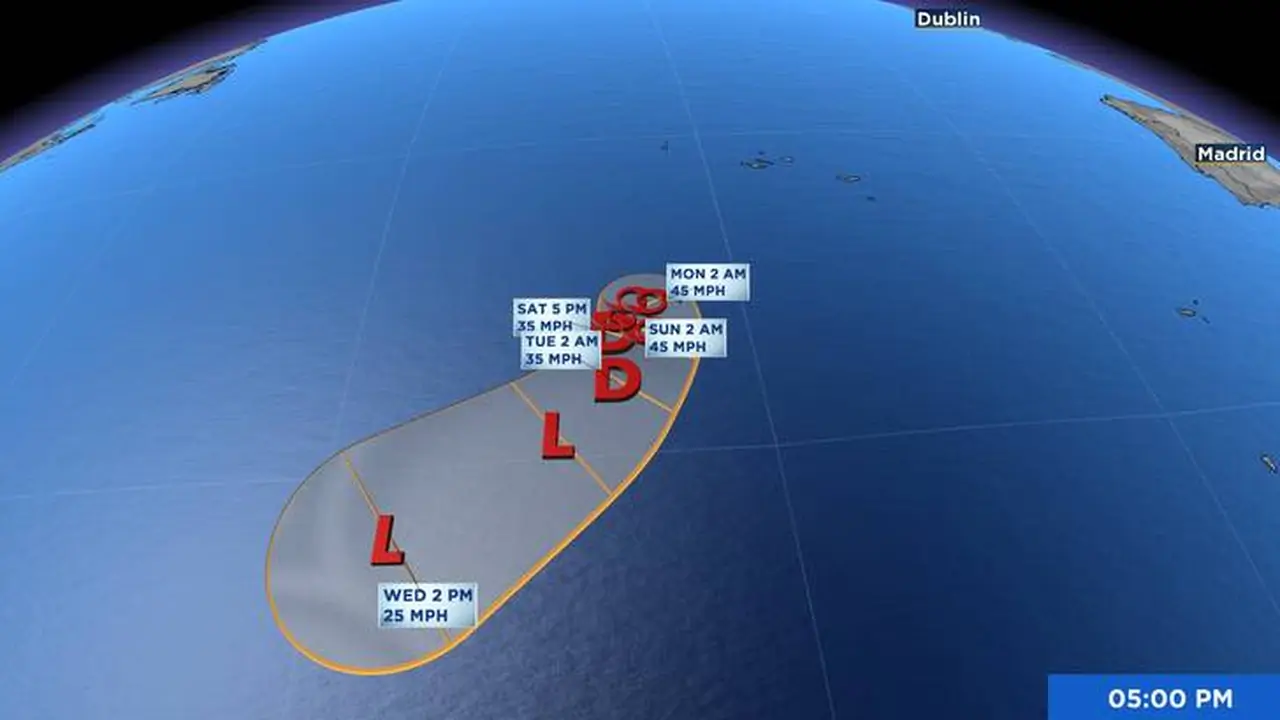
Active Systems: The National Hurricane Center is issuing advisories on Tropical Storm Fay, located several hundred miles southwest of the Azores.
Far Eastern Tropical Atlantic (AL90): A broad area of low pressure located a few hundred miles south-southeast of the Cabo Verde Islands is producing a large area of disorganized showers and thunderstorms. This system could become a short-lived tropical depression or a tropical storm later today or on Friday while it moves northwestward to northward. Increasing upper-level winds, however, should prevent further development by the weekend. Interests in the Cabo Verde Islands should monitor the progress of this system as gusty winds, areas of heavy rain, and flash flooding are possible over the islands by Friday. * Formation chance through 48 hours, high, 70 percent. * Formation chance through 7 days, high, 70 percent.
Public Advisories on Tropical Storm Fay are issued under WMO header WTNT31 KNHC and under AWIPS header MIATCPAT1. Forecast/Advisories on Tropical Depression Fay are issued under WMO header WTNT21 KNHC and under AWIPS header MIATCMAT1.
Posted 17 minutes ago by NHC Forecaster Forecaster Roberts

Special Features
Tropical Storm Fay: Tropical Storm Fay is centered near 29.8N 40.5W at 24/0900 UTC or 830 nm WSW of the Azores, moving W at 6 kt. Estimated minimum central pressure is 1010 mb. Maximum sustained wind speed is 35 kt with gusts to 45 kt. Peak seas to 11 ft are occurring within 75 nm across the NW semicircle. Scattered moderate isolated strong convection is noted within 120 nm NE and 45 nm SW quadrants. Fay is forecast to maintain minimal tropical storm strength and move westward through Fri morning then begin to weaken through this weekend.
Please read the latest HIGH SEAS FORECAST issued by the National Hurricane Center at website - https://www.nhc.noaa.gov/text/MIAHSFAT2.shtml and the latest Fay NHC Forecast/Advisory and Public Advisory at www.hurricanes.gov for more details.
Far Eastern Tropical Atlantic (AL90): An area of low pressure located a few hundred miles south-southeast of the Cabo Verde Islands is accompanied by a large area of disorganized showers and thunderstorms mainly E of 26W. A tropical wave accompanies this low. This system could become a short-lived tropical depression later today or on Friday while it moves northwestward to northward. However, strong upper-level winds should end the opportunity for development by the weekend. Interests in the Cabo Verde Islands should monitor the progress of this system as gusty winds, areas of heavy rain, and flash flooding are possible there by Friday. This system has a medium chance of formation in the next 48 hours.
Heavy Rainfall in Central America: A mid to upper-level trough currently extends from the eastern Gulf of America across the Yucatan Peninsula and NW Caribbean, while relatively warm sea surface temperatures and abundant low level moisture are present. An elongated low level trough will prevail across this area during the next several days, and aid in funneling enhanced tropical moisture across Central America and the western Caribbean, supporting periods of heavy rainfall through Sat the 26th. There is still some uncertainty regarding the exact location of heaviest rainfall, but for now heavy rainfall looks likely across extreme southeastern Mexico near Chiapas, southern and central Guatemala, western Honduras, El Salvador, southern and eastern Belize, as well as across portions of Costa Rica and Panama. Currently, heavy rainfall is ongoing from northern Honduras, E of 87W, north- northeastward across the Cayman Islands and into the southern coastal waters of Cuba, and across Andros Island and the remainder of the NW Bahamas W of 75W. Heavy rainfall across these regions will create the possibility of life-threatening flash flooding and landslides. Please refer to local weather services as well as the International Desk at the Weather Prediction Center for more information.
Tropical Waves
See Special Features section above for information on a tropical wave in the far eastern Atlantic along 20N that has potential for tropical formation.
A central Atlantic tropical wave is analyzed along 47W, S of 13W, moving west at around 10 kt. Scattered moderate convection is noted within 60 nm of the wave axis along the monsoon trough from 09N to 11N.
An eastern Caribbean tropical wave is along 65W, south of 14N into southern Venezuela, moving westward at 10 to 15 kt. Scattered moderate convection is noted S of 12N between 60W and 64W, while numerous moderate to strong convection is near the wave axis well inland from 01N to 08N.
Monsoon Trough/ITCZ
The monsoon trough enters the E Atlantic near 20N16W and meanders southward to 1008 low pressure near 12N21W then continues westward to 10.5N47W. The ITCZ extends from 08N49W continues to the coast of Guyana near 08N59W. Scattered moderate to strong convection is noted within 90 nm on either side of the boundary and E of 32W, and from 09N to 13N and E of 49W.
Gulf Of America
Deep-layered upper troughing continues across the eastern Gulf from the coastal Carolinas across N Florida to the eastern Bay of Campeche. Multi-layered clouds and scattered moderate convection is noted from the Yucatan Peninsula northeastward across the Straits of Florida and south Florida and into the Bahamas. To the west, widely scattered showers are occurring along a surface trough across southwest portions from Cabo Rojo, Mexico the the central Bay of Campeche. At the surface, weak high pressure prevails across the northern Gulf, ahead of an approaching cold front extending just inland across the northern Gulf states and across the coastal waters of the Florida Big Bend. Gentle to moderate E-NE to E winds dominate the Gulf N of 25N, with 2-4 ft seas. Light to gentle winds prevail south of 25N, except for moderate N to NE winds along the NW coast of the Yucatan.
For the forecast, the weak pressure gradient will generate gentle to moderate winds across the remainder of the basin through today. The upper-level trough will support scattered showers and thunderstorms over the SE Gulf and the Straits of Florida for at least the next couple of days. The front is forecast to progress across the E Gulf tonight and Fri, then stall over the SE Gulf this weekend.
Caribbean Sea
Please see Special Features section above for information on upper-level low pressure across the far western Caribbean, and expected to produce areas of heavy rainfall over portions of Central America into the weekend.
To the east, deep-layered low pressure extends from the weak pressure pattern prevails from the central Atlantic southwestward to northern Venezuela. A low level trough is moving across Puerto Rico and interacting with the upper trough to produce scattered showers dotting the waters surrounding Puerto Rico and the Virgin Island and portions of the eastern Caribbean. A tropical wave is across the southeast Caribbean and mostly impacting interior portions of Venezuela with numerous strong showers and thunderstorms.
At the surface, high pressure across the central Atlantic extends a weak ridge into the Bahamas, producing a weak pressure gradient across the Caribbean basin. Moderate trades prevail across most of the basin S of 16N and E of 79W, while fresh to strong winds are S of 13.5N to the coasts of NW Venezuela and extreme NE Colombia. Seas in these winds are 4 to 7 ft, and 3 to 5 ft in the moderate winds. Outside of convection, light to gentle winds and slight seas prevail elsewhere across the SW and NW Caribbean.
For the forecast, the weak pressure gradient will generate moderate to fresh trades over the S central Caribbean, and gentle to moderate winds elsewhere. The upper-level trough will support scattered to numerous showers and thunderstorms over the W Caribbean for the next couple of days.
Atlantic Ocean
See Special Features section above for information on Tropical Storm Fay over the central Atlantic well east-southeast of Bermuda.
A deep-layered upper trough extending from the middle Atlantic states of the U.S. S-SW across the eastern Gulf of America continues to support scattered to numerous showers and thunderstorms from the NW Caribbean across the NW and central Bahamas and adjacent Atlantic waters. Abundant low-level tropical moisture is across much of the Atlantic W of 68W, trapped to the south of an approaching front offshore of the SE U.S. And is interacting with the upper trough. A surface trough is analyzed within this convection across the NW Bahamas through the Straits of Florida. A weak frontal boundary has become stationary across the NW waters from 31N75W to northern Florida. Moderate to fresh N-NE winds are filling in behind this front W of 75W, building seas to 5-7 ft. Another upper-level low is drifting westward near 24N54W, and extends a trough SW across the eastern Caribbean. This feature is interacting with a surface trough resulting in an area of scattered moderate convection from 21N to 26.5N between 49W and 57W. Outside of this convection, a weak pressure gradient continues across much of the Atlantic, as high pressure remains centered across the far NE Atlantic offshore of Europe. This pattern is sustaining gentle to moderate trades S of 20N and variable light to gentle winds elsewhere W of 35W, except for moderate SE to S winds over the area N of 30N between 60W and 70W. Seas are 2 to 5 ft W of 60W, and 4 to 6 ft elsewhere across the basin. However, swell generated from Tropical Storm Fay is producing seas of 6 to 11 ft N of 27N between 36W and 43W.
For the forecast west of 55W, a weak pressure gradient will support gentle to moderate trades across forecast waters through tonight. An upper-level trough will produce scattered showers and thunderstorms west of 65W for the next couple of days. Deepening low pressure across the western Atlantic will push a frontal boundary off the SE United States coast late tonight. The front will shift eastward, reaching from near Bermuda to the straits of Florida Sat night before starting to weaken. Fresh to strong winds and large N to NE swell will follow the front on Thu and Fri, before beginning to slowly subside Sat through Sun.
Posted 2 minutes ago by NHC Forecaster Era

